
Taking photos of buildings was a big part of 2023 for me and I have since been looking for a way to write it up. As 365 moments of hope were involved, this blog seems the perfect place.
New Year’s Day 2023 was suffused with hope, not, for me at least, because it was 2023, but simply because it was a new year’s day. I’m sure it would have been suffused with hope for some people because of the particular new year’s day it was. For example, I imagine that someone somewhere will have sung to their lover the words of one of the most perfect pop songs of all, by The Zombies, “This will be our year, took a long time to come.” And I hope that someone somewhere will have played the mono version of that song to their lover, the version with the horns that add such colour to the song’s feeling of hope, just as the trumpet solo in Penny Lane by The Beatles evokes a “sense of freedom, energy, and sheer happiness” (Mark Hertsgaard).
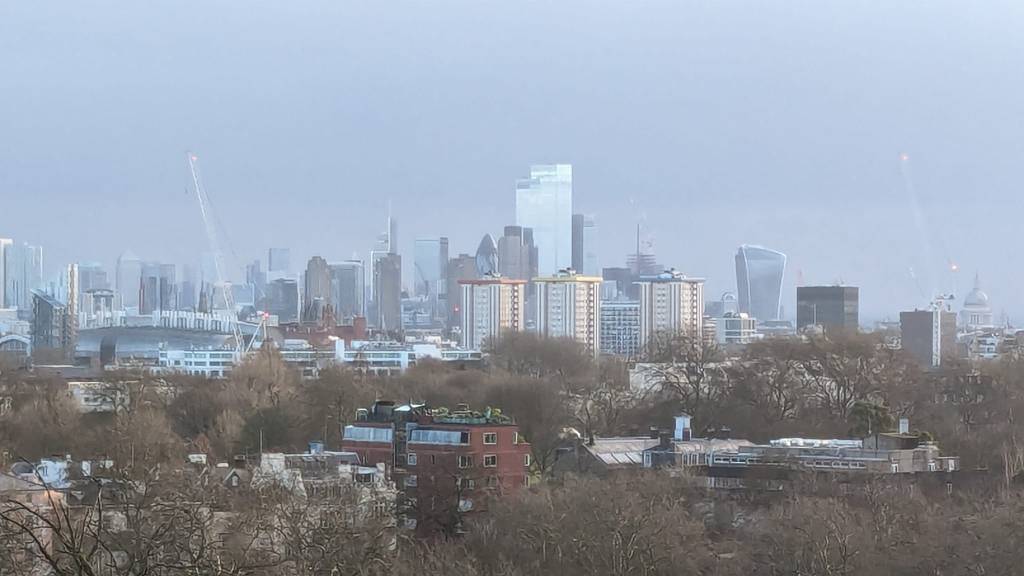
For me though, as far as I recall, my hope on 1st January 2023 was of the more generalised type that one can feel at a beginning, for example of a year. It was enhanced as I walked from Waterloo Station to the British Film Institute – to watch Metropolis with my friend Dave – by the appearance of one of my favourite London buildings, the Royal Festival Hall. As the Open University’s From Here to Modernity team say, this is a building that seems “to make a concrete offer of a better world ahead”. On this late New Year’s Day afternoon, the top of the building was glowing green, apt in its symbolism of renewal, which I doubt I thought consciously at the time, but I liked how it looked enough to want to take a photograph of it. Spontaneously I decided to post the photo on Facebook, as a sort of New Year’s greeting to my friends there, and also spontaneously I had this thought, typing virtually at the same time the idea was occurring to me, as we continued on our way to the cinema:
“Approaching one of my favourite buildings en route to see a film at the BFI and thought, why not take a photo of a building that I like or find interesting, each day of the year in 2023, and post it on Facebook? And I couldn’t think of a reason why not, so here’s the first.”
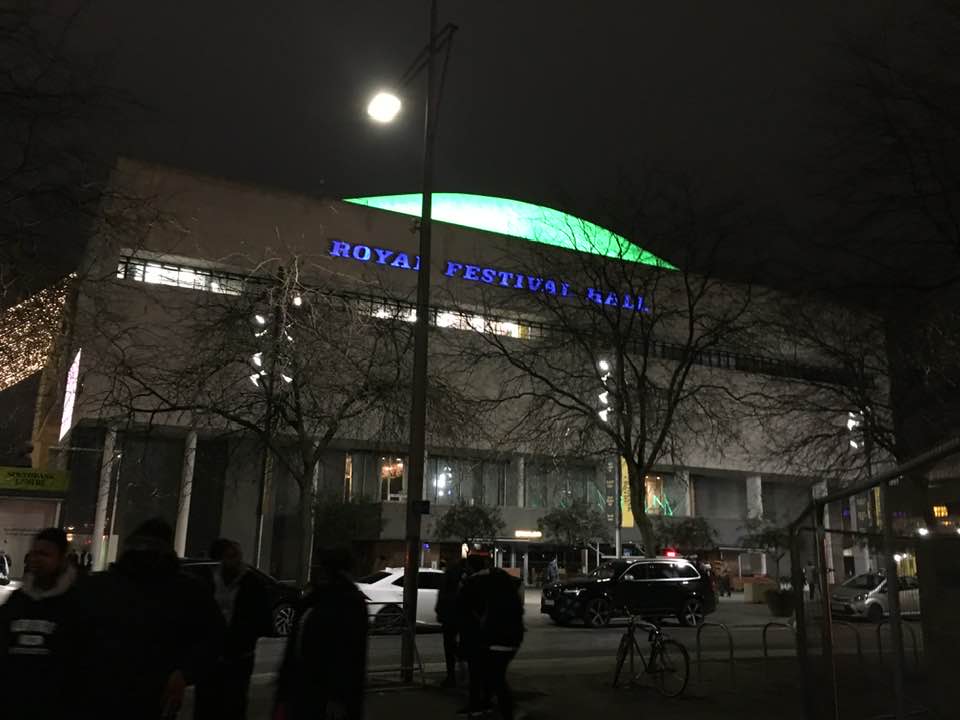
The next day, I posted a photograph of my East London flat, and wrote: “Have decided on three rules (so far) for this project: 1) only one photo a day, 2) no, or little commentary, 3) I can break the rules whenever I want.”
So that was the beginning of my 2023 building of the day project on Facebook. I did go on to post 363 more photos of buildings that I took on each of the days of that year, and I often broke Rule 2, as I did sometimes write something to accompany the photo of a building I had seen that day that I had liked or that had interested me in some way.
It was during that year that I became registered to do a PhD for which I would research the role of hope in activism, and I began to read about hope in earnest, but I don’t think I connected the idea of hope with my building of the day project until almost the very end of it. My friend Sybil had joined me in also taking and posting a photo of a building every day on Facebook, and she wrote under my photo of 28th December (of her beautiful home as it happens), “Thank you Guy for the idea. Makes me look up. That is the way that Hope works”.
The sociologist, Les Back, has talked about hope as “an attention to the present and the expectation that something will happen that will be unexpected” and that we can find hope “through training an attentiveness to the social world in troubled times”. He asks about where might we look and listen for hope, and what I had discovered by the end of 2023, partly through Sybil’s help, is that one place to look for it is in the buildings around us.
Looking makes you see differently. Another friend who commented, on my last post of the year, thanked Sybil and me “for making me look with different eyes”. I spent a number of days working in Rotherham in 2023, and about to take a train back from there to London, one day in September, I was casting my eyes around for a possible candidate. I suddenly realised that the train station itself, which I’d passed through several times but hadn’t noticed, was a striking looking building. When I posted the photo later, a friend who had been brought up just outside Rotherham commented: “I’ve also never looked at it properly. It’s gorgeous”. If hope is about looking up, it’s also about looking at and seeing things differently.

As I look back at the photographs now, and my accompanying bits of commentary, the hope is obvious. On two consecutive days in February, I photographed St Joseph’s Hospice in Hackney, and part of the postwar Cranbrook Estate on Roman Road, heading from Bethnal Green towards Bow. St. Joseph’s is one of the oldest hospices in the country, founded by the Sisters of Charity in 1905. I wrote under my photo, “None of the buildings here now look so old, and the various parts of it were clearly built at different times. This is my favourite, a beautiful building for a beautiful thing humans have developed in modern times, the hospice movement.”

The 1963 “post-war utopian social housing” of the Cranbrook Estate, designed by Francis Skinner, Douglas Bailey and an older mentor, the Soviet émigré Berthold Lubetkin, includes 6 tower blocks, lots of low rise homes, a community centre and a residential development for the elderly, Tate House, in the garden of which stands a fine public sculpture, The Blind Beggar and His Dog, by Elizabeth Frink.

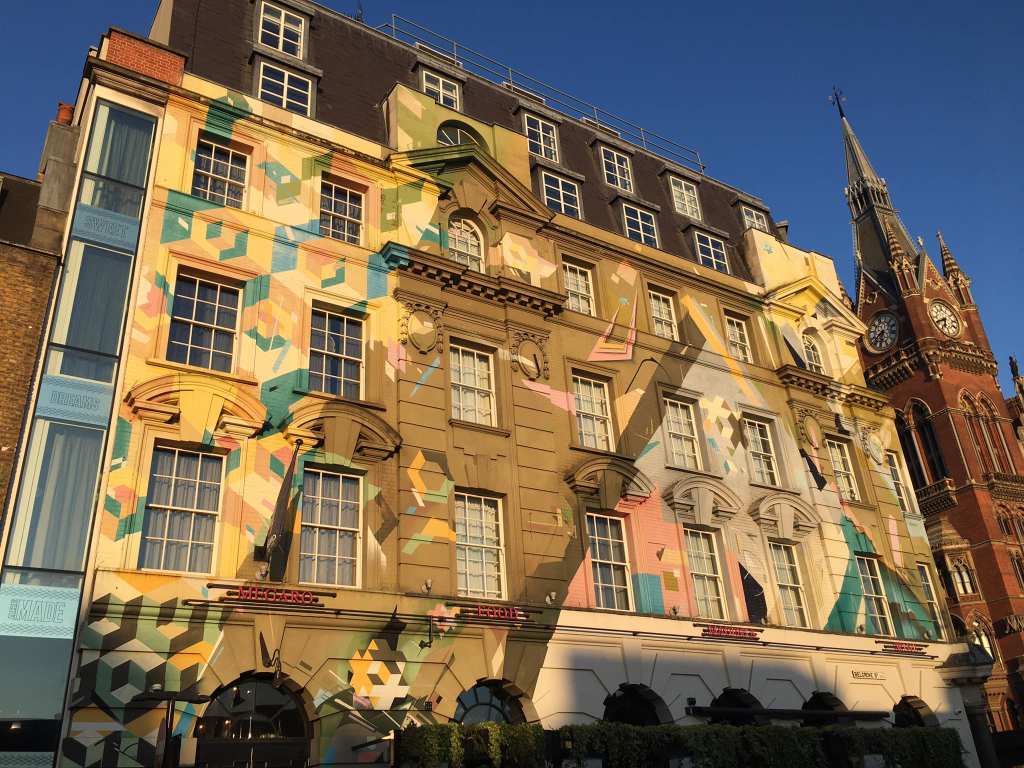
Arrivals and departures contain hopeful moments, and several of my daily entries reflect this. Later in February, I took a photo when I arrived back at St Pancras Station after working in Sheffield, and noted, “What an entry into London!” One of the commenters underneath added, “Always makes my heart sing”. In April, about to head via King’s Cross to Darlington: “The amazing mural on this building opposite King’s Cross/St Pancras, on the corner of Euston Road and Belgrove Street, caught my eye. It often does but it looked particularly good in the early morning sun.”

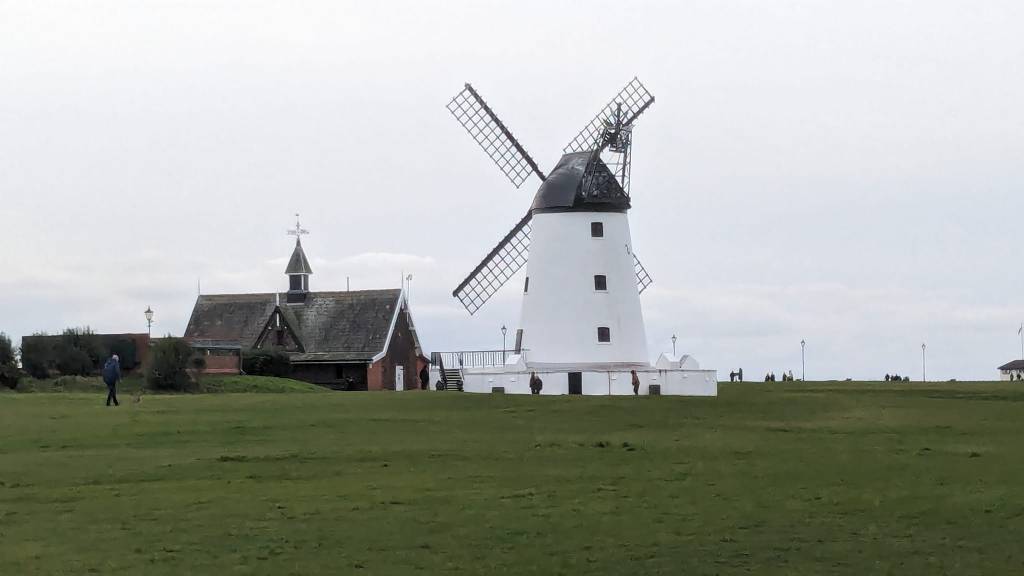
I spent Christmas with family, and on Boxing Day I was with my sister who lives near Lytham, near where we were brought up in Preston. My brief comment under the Lytham windmill contained a lifetime of childhood memories:
“Here it comes, round the bend to the right, there it is! The sign that we’d arrived, at Lytham, at the sea, at Lytham St Annes, often en route to St Annes open-air baths – the windmill at Lytham. Not many better sights to come into view.”
Looking again at the photos and re-reading my comments, I can see so many moments of hope, from visits to Palestine, and Greece, from realising that my daily cycling around Bethnal Green took me past some masterpieces of brutalist architecture, from public buildings erected to serve the community, churches with spires soaring to heaven, pubs filled with people meeting and hoping together. I shall revisit some of these in more detail in future blog posts.
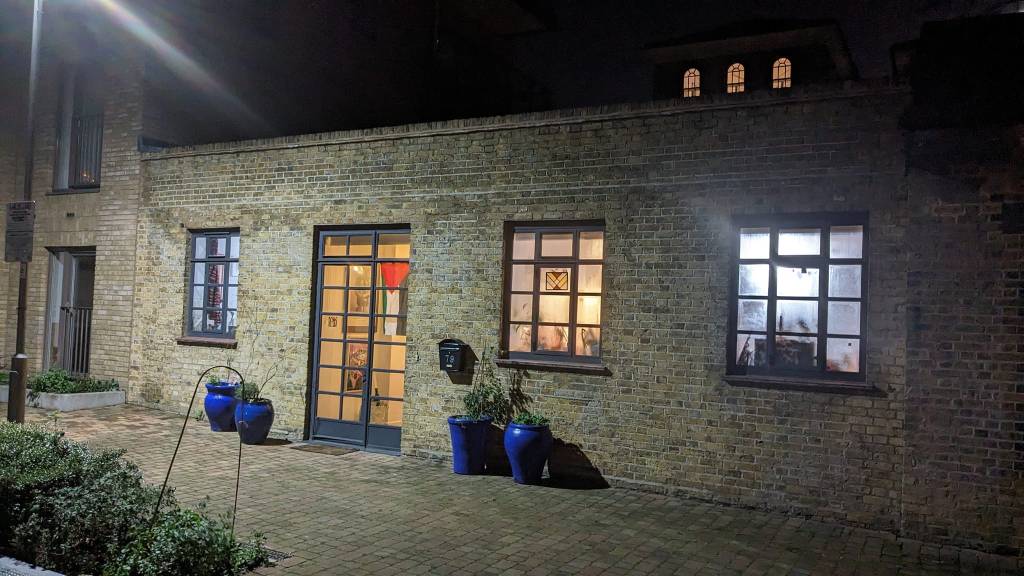
I took my last photo, on New Year’s Eve, from the top of Primrose Hill looking towards the buildings of London on the southern horizon. I had arrived that morning “to a cloud-covered sky, but before too long the sun appeared above the clouds, and bathed the buildings of this London skyline in the light you see here”.

George Martin once said of the Beatles, “They would always want to look beyond the horizon, not just at it, which might explain a lot”. The final hope I shared in my building of the day project on Facebook was that “we can look up towards our hopes in 2024, and may we see the light behind and beyond the clouds”.


Leave a reply to sybil cokc Cancel reply