
Being invited to give the opening keynote at the annual UKASFP conference has led to me creating the blog I have been meaning to create for some time now – so thank you to the conference organisers. Here is the first post. One moment of hope has led to another…
Last week I spoke in Bradford, this year’s City of Culture, but left some words unsaid. I gave the opening keynote at this year’s conference of the UK Association of Solution-Focused Practice (UKASFP), on Solution-focused practice and hope(s). That it was unfinished – having unwisely tried to pack too much in, I ran out of time – was appropriate, given that one of its subjects was the 20th century German philosopher, Ernst Bloch, “the pugnacious philosopher of hope”, as Jack Zipes called him in his 2020 biography.
For Bloch’s central idea was that the world is unfinished. In a constant process of becoming, “the world is full of propensity towards something, tendency towards something, latency of something” (Bloch, 1986, p18). The philosophy of the future that Bloch developed was also a philosophy of movement, so it fits beautifully with the solution-focused approach to change, the intended movement of which is always towards the hopes of the people or communities with whom it is used.
My keynote was on the topic of solution-focused practice and hope(s), the bracketed s being there to indicate the two modalities of hope suggested by anthropologist, Stef Jansen (2016), the intransitive and transitive. The intransitive modality is a feeling, the affect of hopefulness, which is not necessarily attached to any object, whereas the transitive is a hope for something, or a hope that something will happen, for which Jansen uses the word hopes. This is also the hope, or rather hopes, of solution-focused practice, which is no more, and no less, hopeful than any other therapeutic approach, in the first of Jansen’s meanings.
The keynote represented a moment of hope for me, and also, I would venture, for the participants of the UKASFP conference as a whole. The beginning of any conference – many (most? all?) beginnings in fact – will be suffused with hope, as the people gathering look forward to what is to come. For my part, it was the first time that I would be sharing with people in the solution-focused world some of my learning and thinking about hope that I have been engaging in over the last couple of years. This is the result of an opportunity to do some research, the focus of which I intend to be the role of hope – or hopes – in social and political activism.
Moments of hope is a phrase used by another anthropologist, Hirokazu Miyazaki, in his book, The Method of Hope, in which he draws on Bloch’s philosophy – and also that of Richard Rorty and Walter Benjamin – for his study of the hopes of people in Fiji. Miyazaki became interested in hope first as a methodological problem in apprehending the Fijians’ hopes, given the incongruity between his retrospective analysis of these hopes and the prospective orientation of hope itself:
“The retrospective treatment of hope as a subject of description forecloses the possibility of describing the prospective momentum inherent in hope… the newness or freshness of the prospective moment that defines that moment as hopeful is lost”.
With the help of Bloch in particular, Miyazaki realised he had to stop looking back at hope, and reorient his attempts to apprehend it forwards. Rather than treating hope as a subject of analysis, he approached it instead as a method. I did actually manage to get this far in my talk, to share some of this account of Miyazaki’s, and to own up to a less than full understanding of the method of hope that he subsequently developed. To anticipate an idea of Bloch’s to come later in this post, this is part of my Not-Yet Conscious. Miyazaki’s method involves a concept of replication, whereby he seeks to apprehend the hopes of the Fijians he studied via his own hopes, as an anthropologist, to formulate anthropological knowledge. My incomplete understanding of this has not prevented me from finding Miyazaki’s approach useful, both in planning my research design for studying hope, and in seeing solution-focused practice itself as a method of hope, but that is for future blog posts.
This one is about moments of hope. The moment of hope of my keynote presentation was partially fulfilled, in that I did share some of my thoughts and learning about hope, both from my experience as a solution-focused practitioner and trainer, and from my reading of some philosophical, anthropological and sociological literature. That it was unfulfilled, in particular that there were some things I hoped to share but did not have the time to do so, has led to another hopeful moment – this blog post. For this is the first post in the blog I have been meaning to create for some time, a blog to collect, collate and curate ideas in relation to my experience and my reading, and to extend my cognitive processes around these ideas by exposing them to other people and their ideas. Each post of the blog will be a hopeful moment, as all new writing is, and the blog as a whole will become a hopeful moment – or perhaps a world, “full of propensity towards something, tendency towards something, latency of something”.
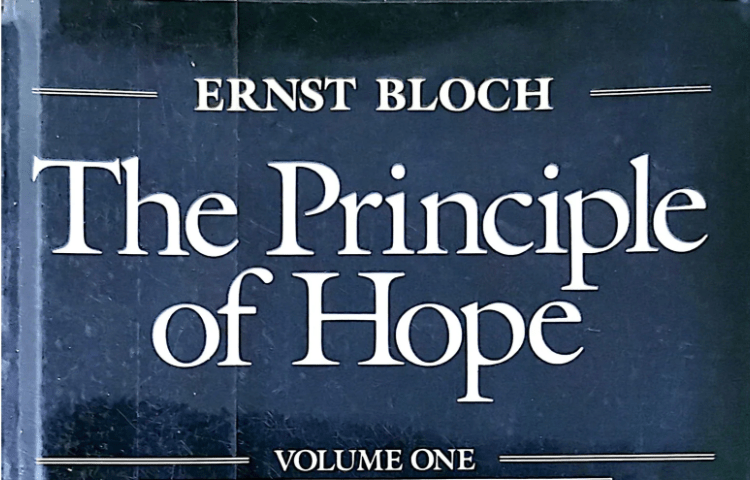
Repeating his words returns me to Ernst Bloch. I first encountered him in Terry Eagleton’s book, Hope Without Optimism (reviewed here), and then again in a book called Hope by the music sociologist, Tia De Nora, which has the subtitle The dream we carry. Dreams of a Better Life was originally going to be the title of Bloch’s major work, The Principle of Hope, and daydreams play an important part in Bloch’s thinking. In contrast to the Western philosophical tradition dating back to Plato, Bloch’s philosophy opens up a space for the future. The retrospective contemplation of Western philosophy pays attention only to What Has Become, whereas for Bloch, possible futures are also part of our reality, alongside the past and present, so a focus is also required on what has Not Yet Become.
The subjective counterpart to this is our Not-Yet Consciousness, and Bloch develops this notion by contrast with Freud’s ideas of the unconscious, most beautifully in a section of The Principle of Hope headed “The two edges”. Bloch terms Freud’s unconscious as the No Longer Conscious, in which lies stuff we have forgotten or repressed. So, one edge of consciousness is where something slips away, moving past this edge as we forget it, and “there is another edge, beyond which what is not yet conscious dawns”. Bloch poetically continues, “Here the subject scents no musty cellar, but morning air”. Things dawn on us, they may enter descriptions of preferred futures (to use some solution-focused jargon), or via our daydreams.
Continuing to prepare my keynote on the train to Bradford, I was reminded at this point of advice I was once given by an artist friend, Tim. When I told him I was travelling somewhere by train, and that I was looking forward to reading, “Don’t read all the time”, he said, “Look out of the train window too, and daydream”. We need dreams, says Jack Zipes, to generate options and find renewed joy; “they are the art of utopia and are filled with our wishes and anticipatory illumination.”
For Bloch, daydreams are not escapist fantasies, but active projections of a better, possible future. This better future is to be found not only in our daydreams, but is also presaged by the utopian elements present in art, literature, music, and many everyday experiences, “the forward-dawning of the future as it is anticipated in unexpected corners of the present”, in the words of anthropologists, Nauja Kleist and Stef Jansen.
Superman might be one such corner. His association with a better world has been clear since his very first appearance, in Action Comics #1 in1938, where he was billed as “Champion of the Oppressed”. A year later he was given the name the “Man of Tomorrow” for the first time at the New York World’s Fair #1 that had a Futurama exhibit depicting “the World of Tomorrow.” So, Superman has always been a hopeful figure, and by all accounts this is brought to the fore in the new Superman film released in the week prior to the conference. One thing above all I’d liked to have included in my keynote was a slide showing the headline of a review of the film, “Superman: Hope is Punk Rock”. In the film – that I’ve yet to see – Superman muses on what real punk rock is, and the message of the film is that it is goodness and hope. A nice connection for me, in that I once presented, with Rob Black, on connections between solution-focused practice and punk rock.
Staying with music, the sociologist Ruth Levitas, a supporter of Bloch’s work, has written about the utopian impulses present in music and in particular, collective music-making. The collectivity and sense of community can be added to by the presence of an audience, and “more broadly”, Levitas adds, “music festivals may have this quality of a space out of time, out of the ordinary run of events”. She invites the reader to think Woodstock, and also Glastonbury and Womad. To read of Womad was bitter sweet, as I will miss it this year, having attended every one since my first in 2002, as it is taking a year off.
But the UKASFP conference itself is another collective gathering, another corner of the present, with utopian elements. I am sure that many conferences share such attributes, though just maybe there is something about solution-focused ones in particular. One time I saw the Finnish psychiatrist, solution-focused therapist and TV presenter, Ben Furman, present, he talked about what led him to embrace the solution-focused approach, and part of it was that the participants at its conferences laughed more than at others he’d been to.
I was speaking at the beginning of the 20th UKASFP conference, and, having been to all of them, I knew that there would be lots of enthusiastic talking, respectful listening, and sharing of ideas. Good conferences provide other spaces out of the ordinary run of events, and the fellowship they afford and nurture prefigures a more cooperative future.
Some of what I left unsaid in my keynote I have now said in this blog post, but there will always be more to say, as long as the world is unfinished. So there will be more blog posts, more moments of hope to come. I will end this one with a “noticing suggestion” for you, wherever you now are. Utopian elements are also present in towns and cities, from public spaces to eco-initiatives to cultural provision. Bradford is this year’s City of Culture, and we might look forward to a future where every city is a city of culture every year. At the end of this section on the hope and utopia of Ernst Bloch, my invitation to conference participants would have been to share what utopian elements they had noticed in the city of Bradford since their arrival there. What utopian elements have you noticed in the place where you are reading this, or might you notice, were you to begin looking for them?
References
Bloch, E. (1986) The Principle of Hope. Translated by Neville Plaice, Stephen Plaice and Paul Knight. Cambridge, MA: MIT Press.
Jansen, S. (2016). For a Relational, Historical Ethnography of Hope: Indeterminacy and Determination in the Bosnian and Herzegovinian Meantime. History and Anthropology, 27(4), 447–464.
Levitas, R. (2013) Utopia As Method: The imaginary reconstitution of society. Basingstoke: Palgrave Macmillan.
Miyazaki, H. (2004). The Method of Hope: Anthropology, Philosophy and Fijian Knowledge. Stanford University Press.


Leave a comment