
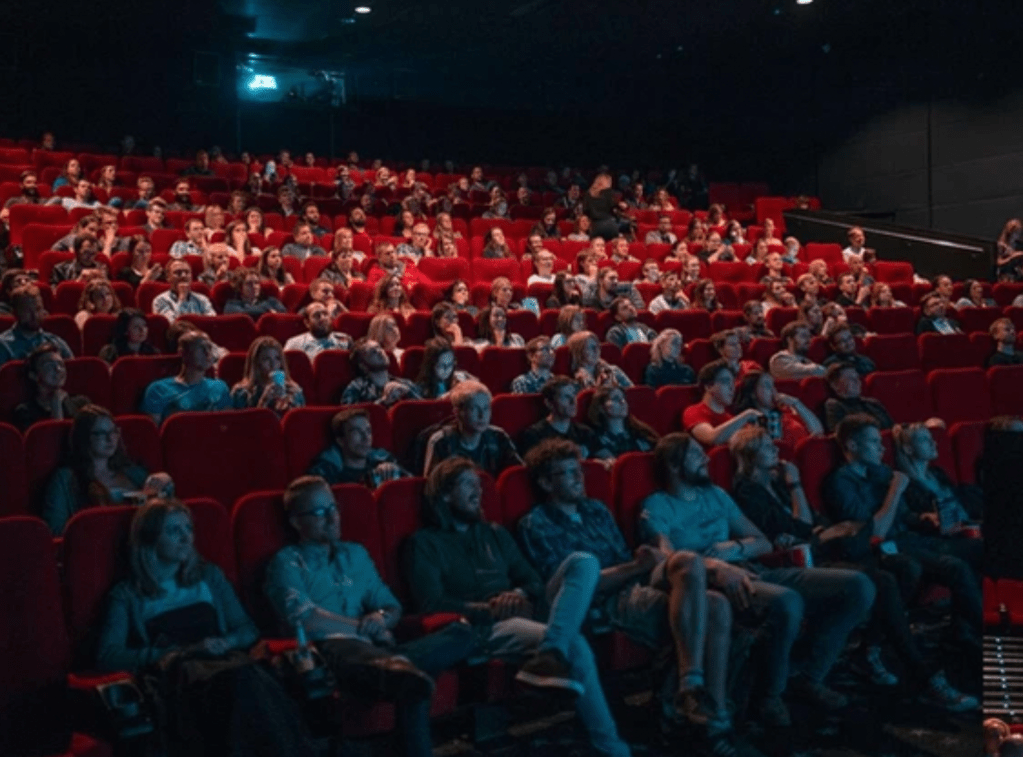
A post about looking up – read it on your phone held above your head!
Where do you like to sit when you go to the cinema? In the middle of a row, or at one end for a quick getaway maybe, or for more leg room. And towards the back, or near the front, or midway?
A mild claustrophobia used to have me sitting at the end of a row, but now I prefer to sit in its centre, and somewhere further back than midway. I haven’t really questioned this until the past few days – which I’ll come onto in a moment – but I think I have assumed you have a better view from near the back. Now that I’m doing the level of reflecting that writing about something can lead to, I wonder if there are other, less conscious associations. An idea perhaps that the cool people sit at the back of places, if smoking and messing about on the back seats upstairs on the bus for example were seen as cool, which they were to me as a teenager on the way home from sixth form. And, as the Drifters said, the back row of the movies on a Saturday night is where the kissing took place.
On Friday night though, we booked seats four rows from the front to see Project Hail Mary and I enjoyed it, both the film and the proximity to the screen.
When you are closer to the screen one thing that happens is that you are more likely to be looking up at it than down, as you might be from the back rows, though I imagine this depends on the size and shape of the cinema. And looking up is something that I definitely wanted to be doing, having recently come across this quote from the French film director, Jean-Luc Godard:
When you go to the cinema you look up, when you watch television you look down.
Seeing this referred to in passing in an article I was reading, I googled it and frustratingly, although I read things like: “as Godard famously said…”, I have not been able to find a definite source for it. It may be that he said it when accepting a César award, France’s main cinema awards, but I don’t know why he said it and what meaning it held for him. Internet commentators suggest he was referring to watching a film in a cinema being a more communal and immersive experience, and watching TV more passive, and I think these things are true but they don’t depend on the different visual orientations of up or down.
Before reading the book, Metaphors We Live By, by George Lakoff and Mark Johnson, I had no idea how much of our language use is metaphorical and the extent to which the metaphors we use are based on our physical make-up. Many metaphors are orientational, the metaphor HAPPY IS UP being one example: I’m feeling up, my spirits rose, you’re in high spirits, seeing her gave me a lift. Layoff and Johnson describe the physical basis for this metaphor being that an erect posture goes along with a positive emotional state.
Admittedly my searching was not that extensive, but the research related to the physical basis for this metaphor does seem to focus on posture, for example that people with an “upright posture reported higher self-esteem, better mood, and lower fear compared to those who slouched” (Peper et al., 2017). I did find a couple of comments about raising one’s eyes increasing alertness, but that this might be because doing so opens up your posture and makes you stand tall. However, looking up cannot just be about posture. It’s possible to look up while slouching, as I found at the cinema on Friday night.
One thing looking up conjures up for me is looking at the sky and thinking about the space beyond it, and the sense of wonder that comes with that. In one of my favourite Peanuts cartoons, the first panel shows Linus from behind, sitting on the ground and looking up at the night sky. Charlie Brown joins him and looks up at the sky too. Linus asks Charlie Brown whether, if a star falls to the ground, he could pick it up and put it in a bucket, to which Charlie Brown replied that he didn’t think so. The next panel shows them continuing to sit silently, looking up at the sky, then in the last one we see Linus throwing his little bucket away. I hope that he wasn’t too disappointed by Charlie Brown’s response, and somehow I don’t think he was, as he always seemed to maintain his sense of wonder.
I’ve referred to looking up before in this blog, in the post about my 2023 building of the day project, in which I reported my friend Sybil as saying that choosing buildings to photograph had made her look up, and “That is the way that Hope works”. And I’ve found this wonderful short film produced by the American Institute of Architects, Celebrating Architecture: Look Up. “To be an architect is to look up even before we put pencil to paper when looking down at a drafting”. Here, looking up comes first.
When looking up at buildings, or trees, or the sky, there is usually movement involved, as you try to take in the whole scene. What is up above us is so much bigger than us that we have to look around, to take it all in. Like taking a panoramic photo on these awful little devices that we look down at so much. And when sitting near the front and looking up at the big screen in the cinema, you might have to turn your head a little from left to right, to see all the action. Maybe they are called movies not just because the picture moves but because the viewer has to move too. If they are near the front and looking up. Which is where I will be sitting from now on, in Linus-like wonder.

 Moments of Hope
Leave a comment