
From Sussex to Nigerian Modernism
After an impromptu visit to the Tate Modern this weekend, I thought I would write what will be in effect a brief addendum to my last post that was inspired by works at the Sussex Modernism exhibition at the Towner Gallery in Eastbourne. The Tate is currently showing an exhibition called Nigerian Modernism, the first time it has collected together modern art from this country. The last room is dedicated to the artist, Uzo Egonu, who was born in Nigeria in 1931, and moved to the UK as a teenager, later studying at the Camberwell College of Art and Crafts. He only returned to his homeland for two days in the 1970s, for a cultural festival, but he remained concerned with African political struggles, and has often been described as “Africa’s greatest modern painter”.
The name given to his room in the exhibition is Painting In Darkness. This was what Egonu called the period from 1979 onwards after he had lost much of his vision from being exposed to toxic fumes while exploring an interest in etching. While “painting in darkness”, Egonu created some of his most expressive and vibrant works. His painting from 1985-1986, Will Knowledge Safeguard Freedom 2, is on the very last wall of the exhibition, by the exit.
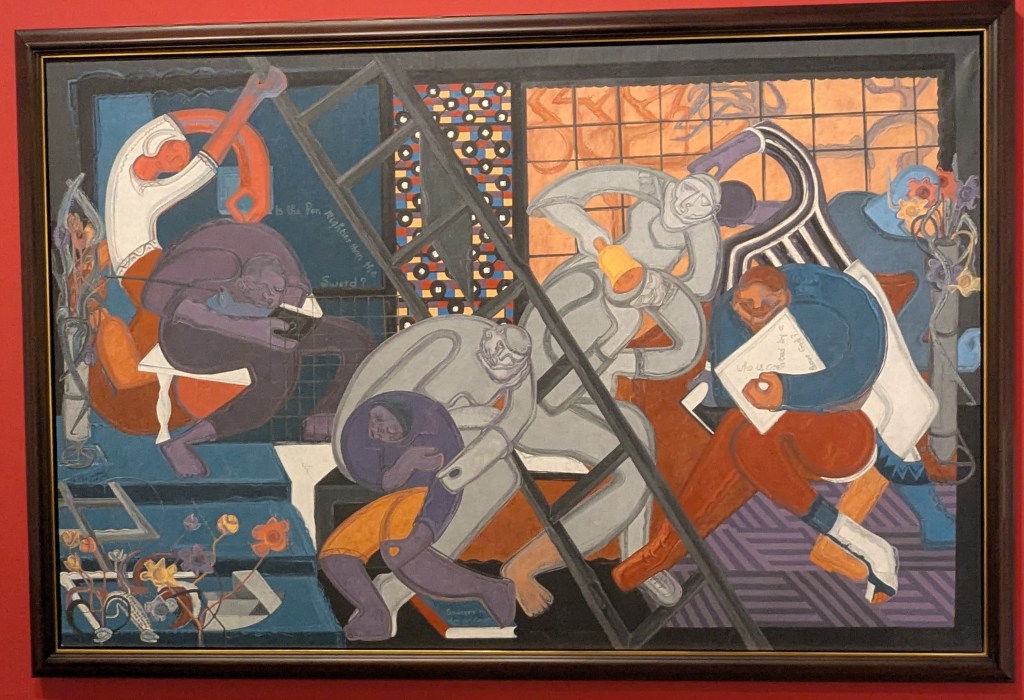
Will Knowledge Safeguard Freedom 2 – Uzo Egonu
The ladder that runs across the painting’s centre was reminiscent of a feature of two of the paintings in the Sussex Modernism exhibition that I commented on in my last blog post, a future-oriented movement at their centres. In the central panels of A Better Life For All, from the International Workers Mural, a boat moves towards the rising sun and, we might assume, towards the hoped-for better life for all. In Campus, in which its painter, Julian Bell, reflects on knowledge, a bridge-like structure at the centre connects the campus to the Sussex Downs, which I saw as carrying knowledge from the university to the world beyond.


The ladder in Egonu’s painting is surrounded by figures engaged in various activities, including reading and writing, and we can see two questions that have been written down: Is the pen mightier than the sword? and Who is created by a lesser God? There is a seeking after knowledge here, though the question posed in the painting’s title leaves open whether knowledge will safeguard freedom, but I assume that is the hope. A hope symbolised by the flowers Egonu has placed on each side of the painting.

The comment placed by the Tate next to the painting says that the ladder remains unused, but who is to say that the characters we see have not used it to arrive at the point where we currently see them? And one of the figures has grasped hold of it, as if intending to use it. The ladder is there for a reason; it suggests possibilities. We cannot see a top or a bottom of it, which adds to a sense of the story the painting tells being open.
The story for Egonu might have been about post-colonial nation-building in Africa, or that may have been one part of it. Nigeria became independent from British rule in 1960, and Egonu was deeply invested in its many struggles following that. These struggles form part of the context of this superb exhibition, which is on at the Tate Modern in London until 10 May 2026.
 Moments of Hope
Leave a comment